
Rarity adds a thrilling element to any collection.
Whether they are NFTs, baseball cards, or toys — it doesn’t matter. Simply put, rarity increases value.
To be clear, works such as Beeple’s Everydays: The First 5,000 Days is not what we are considering here.
That is a one-of-a-kind original design without randomized variations. Individual art pieces however, comprise this $69 million collage upon closer inspection.
These elements can stand alone, highlighting the creativity and effort to complete this masterpiece.
It is rare in and of itself, but not like certain pieces against others found within the same generative NFT collection.

Generative art collections contain different iterations of an identical base design.
It’s comparable to the 8,888 Pudgy Penguins set on Ethereum or the 10,001-piece DeGods NFT collection on Solana.
So now, what could help us assess rarity when it comes to generative NFT collections?
#1 Different from scarcity
Let’s start with these two terms which may appear synonymous but actually differ in application.
Rarity refers to the quality of a particular thing or commodity. It may be something that is valuable though is not necessarily in demand.
The 8,888 Pudgy Penguins collection for example has 15 different types of skin traits but only one of them comes in black. Its rarity is 0.01 percent of the entire set.
Scarcity on the other hand, refers to availability regardless of quality or value.
It indicates necessity for the thing in question but is in short supply due to strong demand.
To illustrate, there are hypothetically only 8 Pudgy Penguins listed for sale but there are thousands of willing buyers.
The fact that these terms cannot be used interchangeably makes the distinction crucial.
Demand does not influence rarity.
A particular NFT will always be rare, regardless of its demand. Conversely, a thing can be considered scarce no matter how rare or common it is.
This makes studying an NFT collection’s current or even potential scarcity a key consideration before making a purchase.
It’s great to own a rare NFT but the collection’s demand which could lead to scarcity is also something to keep in mind.
#2 Rarity tables
The concept of generative art NFT sets are made more understandable with rarity tables.
Before a programmer writes code necessary to generate a collection’s graphics, names and percentages must first be ascribed to its traits.
When finished, these may be added to the metadata of the NFT and made ready for minting.
This is of course once all the other project components, like marketing and support are set in motion.
The majority of the discussion regarding NFT rarity here will be on generative art sets.
If you’re not yet familiar with the concept of generative art projects, there’s a strong chance you’ve already come across one.
These NFT art sets start with a base character and then use random variations of its attributes to produce one-of-a-kind artworks. As an illustration, consider the 8,888-piece Pudgy Penguins collection.
Such generative art projects usually begin with rarity tables. Imagine a spreadsheet with a specific trait and different versions of that trait.
In Pudgy Penguins, the “Face” trait, for instance, has 27 versions. Then, each variation is given a distribution value to add rarity.
The computer code will then proceed to pick characteristics at random, in order to piece together an image using distribution value percentages.
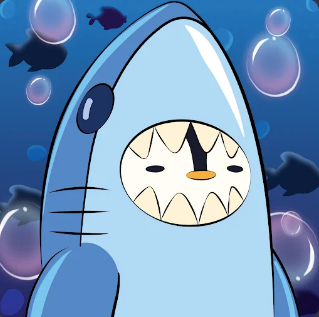
As a result, the Agitated Face trait only appeared once, or 0.011% of the time.
However, the Winking Face feature occurs 961 times, or 10.81%.
Due to the potential usage of a random selection technique, we are unsure of the precise distribution values the Pudgy Penguins team chose for its collection.
However, it can be deduced from this that they wanted the Agitated Face to appear less frequently than the Winking Face variant.
#3 Rarity score
On the developer side of things are rarity tables.
Collectors, on the other hand, use several techniques to determine the rarity of a specific NFT.
Some say that it is rare enough just based on its rarest trait. Some people are more inventive and create statistical models for contrast.
It might also be possible to average out the rarity of its traits.
These may be effective strategies but there is a proven formula. Founder of rarity.tools Jesse Placourakis’s formula however, is more suitable:
Rarity Score for a Trait Value = 1 / ([Number of Items with that Trait Value] / [Total Number of Items in Collection])
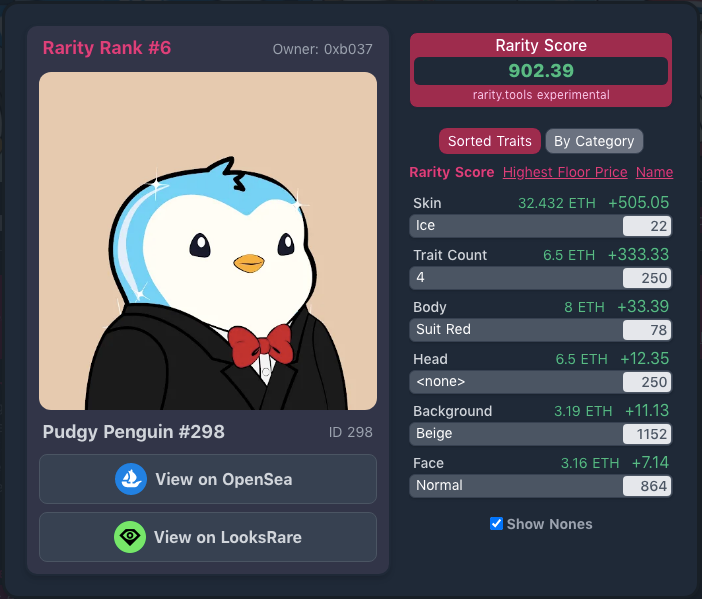
Using the Rarity Score for a Trait Value formula helps assign an amount for each particular trait an NFT has.
Pudgy Penguins #298 is the sixth-rarest NFT in the collection despite having a Beige background occurring 1,152 times.
Its Rarity Score was boosted by rarer traits when applying the Rarity Score for a Trait Value formula.
#4 Calculating rarity
Okay, let’s be honest here.
We won’t be performing any of these rarity calculations manually. It does, however, provide a better understanding of how one can get there.
Thankfully, there are already some trustworthy rarity calculators available.
Rarity.tools, which we briefly discussed in the previous section, comes first.
A drop-down menu of projects is presented to you at first. If your project is one of those on the list, you can then enter its NFT number.
You may access Rarity.tools’ rarity rank within its collection as well as its rarity score. Additionally, you can browse all of the items in the collection in order of rarity.
The following rankings may alter depending on the methodology chosen:
- Average rarity
- Statistical rarity
- Trait rarity
- Rarity score
Rarity Sniper, which began on Discord before getting its own website, is another helpful rarity calculator.
The Discord version requests that you enter a command in the following format on one of its Rarity Check channels: !rarity (project name) ID (number).
It will show its rarity score depending on its attributes, its rarity rank within the collection, and the ratings for each individual attribute.
The values will be the same on its website version, but there will also be a column for trait occurrences.
#5 OpenSea
Particularly the new ones, not all generative art sets will be available on rarity.tools or Rarity Sniper.
You can manually compute the rarity score of an NFT using OpenSea’s characteristics section in the interim.
On the website, look for the Filter tab on the left side. On its mobile app, the same Filter menu is on the upper right corner of your screen.
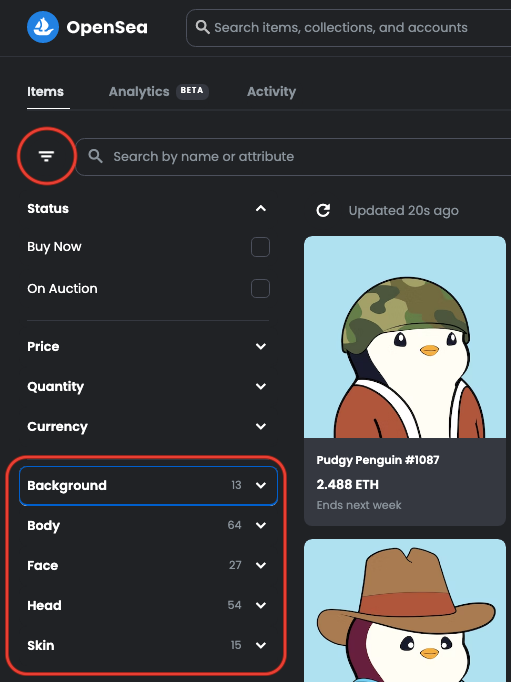
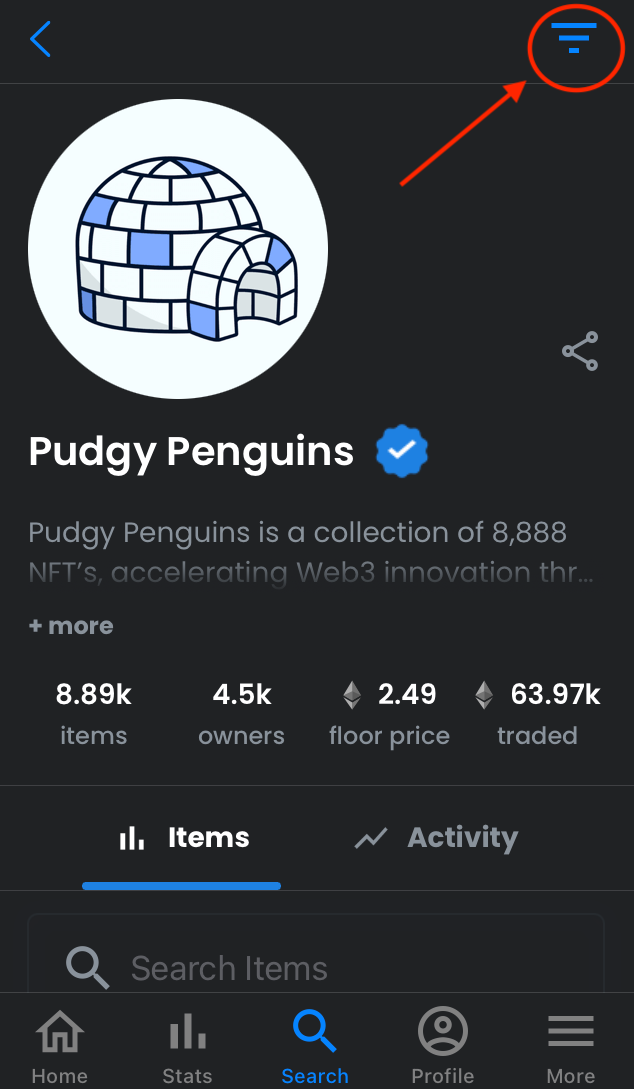
Use these values along with the Rarity Score for a Trait Value formula given above to determine an NFT’s rarity score. It may require some work, however.
It would naturally be quite time-consuming to manually calculate its rarity rank.
Rarity scores for each NFT in the collection require calculating. Cross-checking the results against the complete set is best for better accuracy. In all likelihood, it would be ideal to wait until an NFT collection appears on one of the rarity calculators.
However, if you only want a general idea of how frequently an NFT’s traits are shown, go under the Properties section.
To find the percentage of occurrences for each trait, click on the specific NFT and select the Properties tab.
Although it may not be a precise method of determining rarity, it offers a reasonable indication of how frequently its set of traits appears.
Similar but still unique
Is rarity important?
It does add to an NFT’s value and “flex” factor though there are other motivations for buyers.
Some collectors buy because they like the art.
Others purchase NFTs for the community’s vibe.
There are also potential rewards and benefits which come with it to consider.
Like with most things, choose that which you love first.
You will still appreciate it regardless if you can sell it or not. All other factors are secondary.
Leave a Reply