

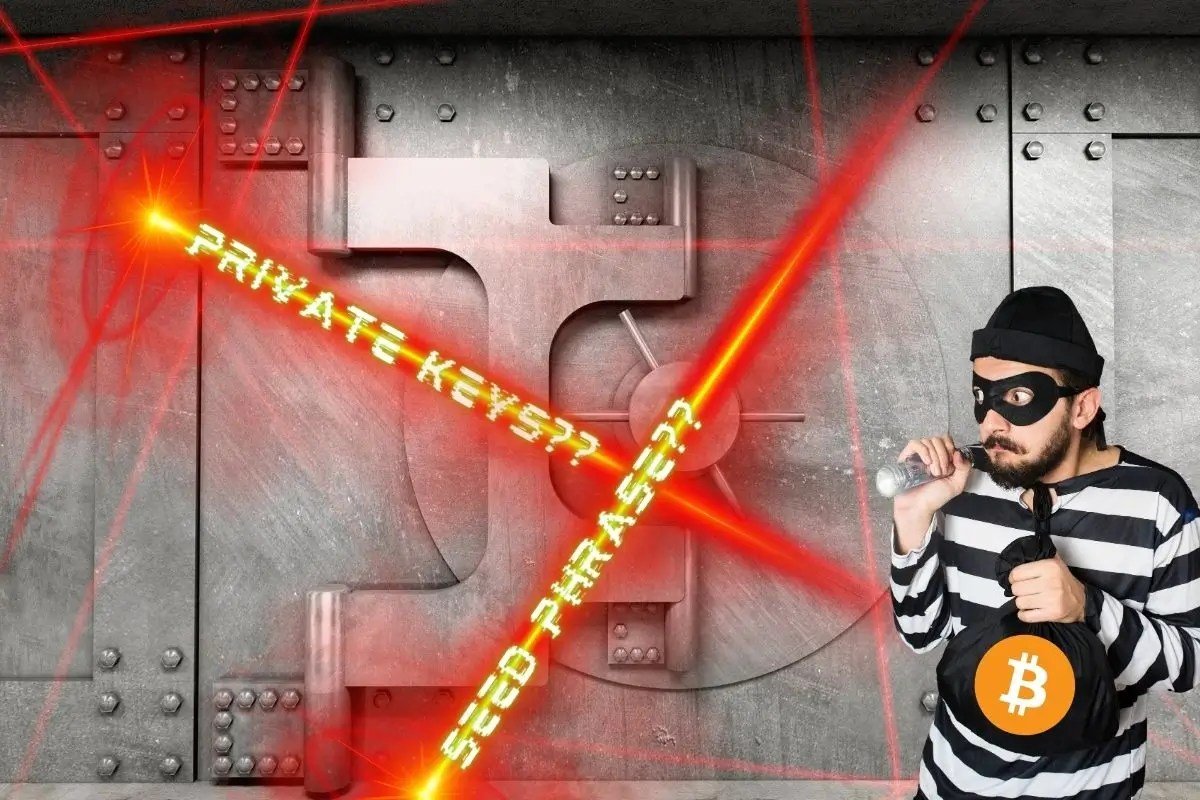
The best way to safely store your crypto is through a crypto wallet, ideally in a “cold wallet” (more on this later).
Avoid leaving them on an exchange, both centralized or decentralized.
Cryptocurrency, like Bitcoin and Ethereum, is digital money you can use to buy things, invest, or trade.
But unlike cash, you can’t just put it in a physical wallet. You need to store it safely on the internet or with special devices.
This article will explain the safest place to store crypto and how to keep your digital money safe from hackers.
To better appreciate the safety of these crypto storage places we’ll have to discuss:
- Public and private keys
- What wallet address is
- Custodial vs. non-custodial crypto storage
- Crypto wallets: Hot and cold
Don’t worry—we’ll keep it simple!
Why Is It Important to Store Crypto Safely?
Let’s say you have a few dollars, and you want to keep it safe.
You wouldn’t just leave it on the sidewalk, right? Instead, you’d put it in a wallet or a piggy bank.
It should be in a secure place where you can easily access your assets.
Cryptocurrency is just like that, except it’s digital, and if you don’t store it safely, it can be stolen.
Failure to store it properly leaves it open to the possibility of being taken from you without your consent.
Imagine you had $100 worth of Bitcoin, and a hacker stole it from your online account. Since there’s no “Bitcoin bank,” no one can return it to you.
Surprise!

You’re the “bank manager” over your crypto assets. So if there’s anyone responsible, it’s you.
That’s why it’s so important to learn how to store crypto safely.
To manage your crypto properly, you’ll need a crypto wallet.
Now, this comes in different types, each with its own public and private keys.
Before we get into it, remember:
Public key = Allows you to receive crypto and includes your wallet’s address. Serves as identification (can be shared).
Private key = The password to access your wallet and send funds. For authentication purposes (kept secret).
What Is a Public Key?
All right, let’s start getting into more details.
A public key is a long string of numbers and letters generated through cryptographic algorithms.
What are cryptographic algorithms?
Think of it like writing a letter in a secret language. Only the person who knows the key (or cipher) to the language can read the letter.
Cryptographic algorithms do the same thing with your information. They take your data and scramble it into a form that no one can read without the right key to unscramble it.
In simple terms, the process is completed through advanced mathematical concepts which we don’t need to discuss here.
Anyway, the process creates a pair of keys: a public key and a private key.
The public key is derived from the private key and is used to create the wallet address. It’s possible to derive a public key again using its paired private key but not vice versa.
Two things:
- The public key is mainly used to generate the wallet address.
- It can be shared publicly, but it’s rarely used directly in transactions.
Imagine the public key as the foundation. It’s like a blueprint to create something simpler for everyday use—your wallet address.

Though a public key and wallet address are related, they are different. Both are used in cryptocurrency transactions, but they serve slightly different purposes.
What Is a Wallet Address?
A wallet address is a shorter, more user-friendly version of the public key.
It’s a hashed (takes data and turns it into a unique fixed-length string of characters) and encoded version of the public key.
This is created to make it easier to send and receive cryptocurrency.
In effect:
- The wallet address is what you share with others when you want to receive cryptocurrency.
- It’s essentially the public-facing “location” where crypto can be sent, similar to an email address or home address.
If the public key is the blueprint, the wallet address is like the actual house number.
It’s what you give to others so they know where to send your crypto.
Key Differences:
- Length and Complexity:
- The public key is typically longer and more complex.
- The wallet address is shorter and designed to be easier to share and use.
- Usage:
- The public key is part of the cryptographic process behind the scenes and is used to generate the wallet address.
- The wallet address is what you share with others to receive crypto.
- Visibility:
- While both the public key and wallet address can be shared without risk, the wallet address is what you will use in day-to-day transactions.
The public key is the raw data used to generate your wallet address.
On the other hand, the wallet address is the simpler, easier-to-use version you share to receive crypto.

Both are important, but the wallet address is what you’ll interact with most when using cryptocurrency.
What Is a Private Key?
Still with us?
Great. This is an important part you need to take seriously.
Yes, seriously.
A private key is like the secret password for your cryptocurrency. Only you should know it.
It’s a long, unique string of numbers and letters that gives you full control over your crypto assets.
When you own cryptocurrency, your private key is what allows you to access your funds and make transactions.
How Does a Private Key Work?
If you want to send Bitcoin to someone else, you need to use your private key to sign or authorize the transaction.
Without this key, you can’t access or move your crypto. You can’t spend it and it is locked until you or somebody else uses it.
So taking good care of your private key is your highest priority as your personal crypto “bank manager”.
Imagine you have a vault where you store your money. The private key is like the only key to that vault.
As long as you keep the key safe, no one else can open the vault or take your money.
Why is the private key important (to make sure you’re paying attention):
- Control: The private key gives you full control over your cryptocurrency. It’s what lets you send or transfer your funds.
- Security: Your private key must be kept secret. If anyone gets access to it, they can steal your crypto. If you lose it, you lose access to your funds forever.
Where Is the Private Key Stored?
In non-custodial wallets (we’ll get to this soon), you control the private key and must store it safely—either in a physical device, a written backup, or a secure digital method.

In custodial wallets, the service provider (like a crypto exchange) holds the private key for you.
“Your keys, your Bitcoin. Not your keys, not your Bitcoin.” – Andreas Antonopoulos: Bitcoin & Open Blockchain Expert, Speaker, Author
Your private key is the ultimate password for your cryptocurrency.
Keep it secret and safe, because whoever holds the private key controls the crypto.
Custodial vs. Non-Custodial Crypto Storage: What’s the Difference?
You have two main options when storing cryptocurrency: custodial and non-custodial storage.
Both involve private keys that give access to your crypto.
Let’s break down what these mean and how they work.
Custodial Crypto Storage
In custodial storage, a third party—like a crypto exchange or a company—holds your cryptocurrency for you.
It’s similar to how a bank holds your money.
You trust the company to take care of your private keys.
If you buy Bitcoin on an exchange like Binance, and you leave it in your Binance account, this is custodial storage. Binance holds your Bitcoin for you, and you can log in anytime to access it.
Pros:
- Easy to use: You don’t have to worry about managing private keys or complicated security steps.
- Convenient: You can log in to your account from anywhere and access your crypto quickly.
Cons:
- Less control: Since the company holds your crypto, you don’t have full control. If the company gets hacked or goes bankrupt, your assets could be at risk.
- Trusting a third party: You need to trust that the company will keep your funds safe and secure.
Non-Custodial Crypto Storage
In non-custodial storage, you are in full control of your cryptocurrency.
You hold the private keys, meaning you have complete access and responsibility. No third party is involved.
If you use a wallet like Ledger or MetaMask, this is non-custodial storage. You own and manage your private keys, so no one else can touch your crypto.
The difference is Ledger is a cold wallet while MetaMask is a hot wallet.

We’ll discuss how they differ in a bit.
Pros:
- Full control: You’re the only one who has access to your private keys, giving you complete control over your assets.
- More security: Since you’re not relying on a third party, there’s no risk of losing your crypto if an exchange is hacked.
Cons:
- More responsibility: You need to manage your private keys carefully. If you lose them, you lose access to your crypto forever.
- Can be complicated: Setting up non-custodial wallets can be a bit tricky for beginners, and you need to be extra cautious about security.
Which Is Better: Custodial or Non-Custodial?
It depends on your needs!
If you want convenience and don’t mind trusting a company, custodial storage is the way to go.
But if you value privacy and security, and don’t mind managing your keys, non-custodial storage gives you full control over your cryptocurrency.
Many people use a mix of both to balance convenience and security.
If safety is your priority however always go for non-custodial storage.
Remember, “Not your keys, not your coins.”
Never leave your crypto on exchanges.
What Are Crypto Wallets?
All right, after that admittedly lengthy (but necessary) build-up, we’re now in this article’s “last quarter”.
A crypto wallet is like a digital vault to store your cryptocurrency.
Just like a real wallet holds cash, a crypto wallet holds your digital money.
Note that a crypto wallet can have multiple wallet addresses. This allows you to segregate your crypto holdings.
It’s similar to having different compartments in a physical wallet or a vault.
This also allows a single wallet to hold different types of cryptocurrency simultaneously such as Bitcoin, Ethereum, and XRP for example.
There are two main types of crypto wallets: hot and cold.
Hot Wallets: Easy but Risky
A hot wallet is a wallet that is always connected to the internet.
These are usually apps on your phone or accounts on a website, making it easy to buy or sell cryptocurrency fast.
Imagine you have a hot wallet on your phone app such as Exodus (also recommended for desktop use).
You can open the app, and instantly send your friend some Bitcoin if you owe them money.
It’s fast and convenient, but because it’s always online, it’s like carrying cash in your back pocket—someone could steal it!
Pros: Hot wallets are good for quick and small transactions.
Cons: They’re more likely to be hacked because they’re connected to the internet.
Cold Wallets: The Safest Place to Store Crypto
A cold wallet is a special device, like a USB drive, that stores your cryptocurrency offline.
Since it’s not connected to the internet, hackers can’t get to it.
If you have $1,000 in Bitcoin and you want to store it safely for the future, you could put it in a cold wallet.
Think of it like locking your money in a safe that no one else can open.
Pros: Cold wallets are the safest place to store crypto because they’re offline and away from hackers.
Cons: They’re less convenient because you have to connect them to a computer to use them.

The industry leading cold wallet options are Trezor and Ledger. This article could help you determine which one is the best for your security.
How to Store Your Seed Phrase Safely
When you set up a crypto wallet, it gives you a secret code called a seed phrase.
This is like a special password that helps you access your wallet.
It’s made up of random words like “apple, river, mountain.” You must keep it safe because if you lose it, you can’t get into your wallet again!
You can write down your seed phrase on a piece of paper and put it in your desk drawer. But this is not recommended.
If someone finds it, they can take all your crypto. So, it’s important to hide it well!
That piece of paper is vulnerable to the elements as well. Fire or water can easily destroy it and your valuable seed phrase along with it.
A far superior method to store your seed phrase however is to use steel or metal-based storage devices.
Here’s how to keep your seed phrase safe:
- Write it down: Never store your seed phrase on your phone or computer. Instead, write it on paper.
- Consider superior seed phrase storing solutions: Want to significantly increase your your seed phrase security? Keep it safe using fire and water-proof materials such as steel or metal-based storage options.
- Store it in multiple places: Keep copies in different locations, like a locked drawer or safe.
- Don’t share it: Never share your seed phrase with anyone, no matter what!

Watch Out for Scams and Hacks
Just a reminder before we wrap up.
Cryptocurrency is valuable, making it a target for scams and hackers.
It’s like having a treasure chest, and thieves want to break into it. Here are some simple ways to protect yourself:
- Avoid phishing scams: Scammers might send fake emails asking for your wallet details. Always double-check before clicking any links.
Example: If you get an email that says, “You won free Bitcoin! Click here to claim it,” don’t fall for it—it’s probably a scam!
- Use strong passwords: Make sure your wallets and crypto accounts have long, hard-to-guess passwords.
Example: A password like “12345” is bad. A password like “MyDogHas2Ears&4Paws!” is much better.
- Enable two-factor authentication (2FA): This means you’ll need to confirm it’s really you by entering a code sent to your phone before you can access your account.
Conclusion: How to Store Crypto Safely
The safest place to store crypto is in a cold wallet, but using both hot and cold wallets gives you flexibility and protection.
Keep your seed phrase safe, and always be on the lookout for scams.
But please, if you’re holding a good amount of crypto beyond $10,000 it makes sense to invest in a metal-based seed phrase storage device.
Check out this 6mm-thick titanium storage device at the Ledger shop. It’s waterproof, fireproof, corrosion-proof, hackerproof, and bullet-proof!
By following these steps, you’ll make sure your cryptocurrency is well-protected and can continue to grow over time.
Stay safe!
FAQs
• Are Crypto Wallets Safe?
Yes, crypto wallets can be very safe if used correctly!
It’s like storing your money in a secure vault, but it depends on the type of wallet you use.
Cold wallets, which are offline, are the safest because they can’t be hacked. Hot wallets are online and easier to use but can be more vulnerable to hackers.
Always pick a trusted wallet and follow good security practices.
• Can Crypto Wallets Be Hacked?
Yes, hot wallets (which are online) can be hacked if you’re not careful.
Hackers might try to steal your crypto if you don’t protect your wallet with strong passwords or two-factor authentication.
Cold wallets (which are offline) are much harder to hack because they aren’t connected to the internet. So, they are considered the safest option.
• How Do Crypto Wallets Work?
A crypto wallet works by holding your private keys, which are like secret codes that let you access and manage your cryptocurrency.
Think of it like the password to your treasure chest.
When you want to send or receive crypto, your wallet signs transactions with this code.
There are two main types: hot wallets (online) and cold wallets (offline).
• What Crypto Wallets Are the Best?
The best crypto wallets depend on what you need.
For safety, cold wallets like Ledger and Trezor are great because they store your crypto offline.
If you want easy access for everyday use, hot wallets like Coinbase Wallet or Binance Wallet are popular choices.
It’s best to use both types to stay safe and make quick transactions when needed.
• Where Are Crypto Wallets Stored?
Crypto wallets can be stored in different places depending on the type. Hot wallets are stored online, either on a website or app.
You can access them through your computer or phone. Cold wallets are stored offline, usually on a special device like a USB stick.
You keep this device in a safe place, like a drawer or safe, just like you would with cash.
• Which Crypto Wallets Are Safe?
The safest wallets are cold wallets, like Ledger or Trezor, because they keep your crypto offline and away from hackers.
For online wallets, Coinbase Wallet and Exodus are considered safe, especially if you use strong passwords and enable two-factor authentication.
Always make sure to use a trusted wallet and protect your keys!
Leave a Reply to How to Buy Cryptocurrency: A Step-by-Step Guide for Beginners – GM Cryptoverse Cancel reply